Server-side risk management — trading rules enforced before your broker
Server-side risk management means your trading rules — lot sizing, SL/TP mapping, maximum open positions, min/max lots — are enforced on PipSync's servers before any order is sent to your broker. A client-side EA enforces rules only while its terminal is running; server-side rules apply to every order, every time.
Billed at checkout · Cancel any time · Free plan available
Risk warning: Trading CFDs and other leveraged products is complex and carries a high risk of losing money rapidly because of leverage. Industry data indicates that 70–80% of retail trading accounts lose money on these products. Risk disclosure · Past performance.
This is a reliability feature, not a performance promise. Risk rules cut out operational mistakes — oversized positions, missing stop-losses, too many open positions — but market risk remains entirely yours. PipSync is a signal execution tool, not a signal provider and not investment advice.
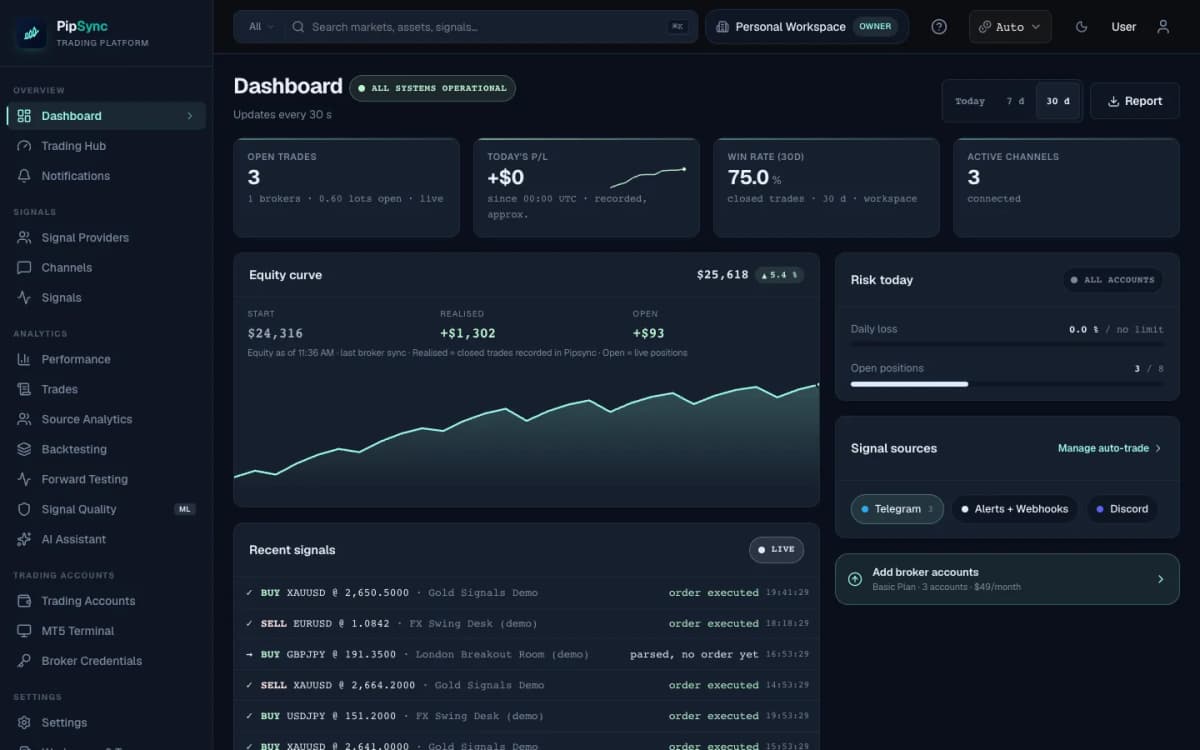
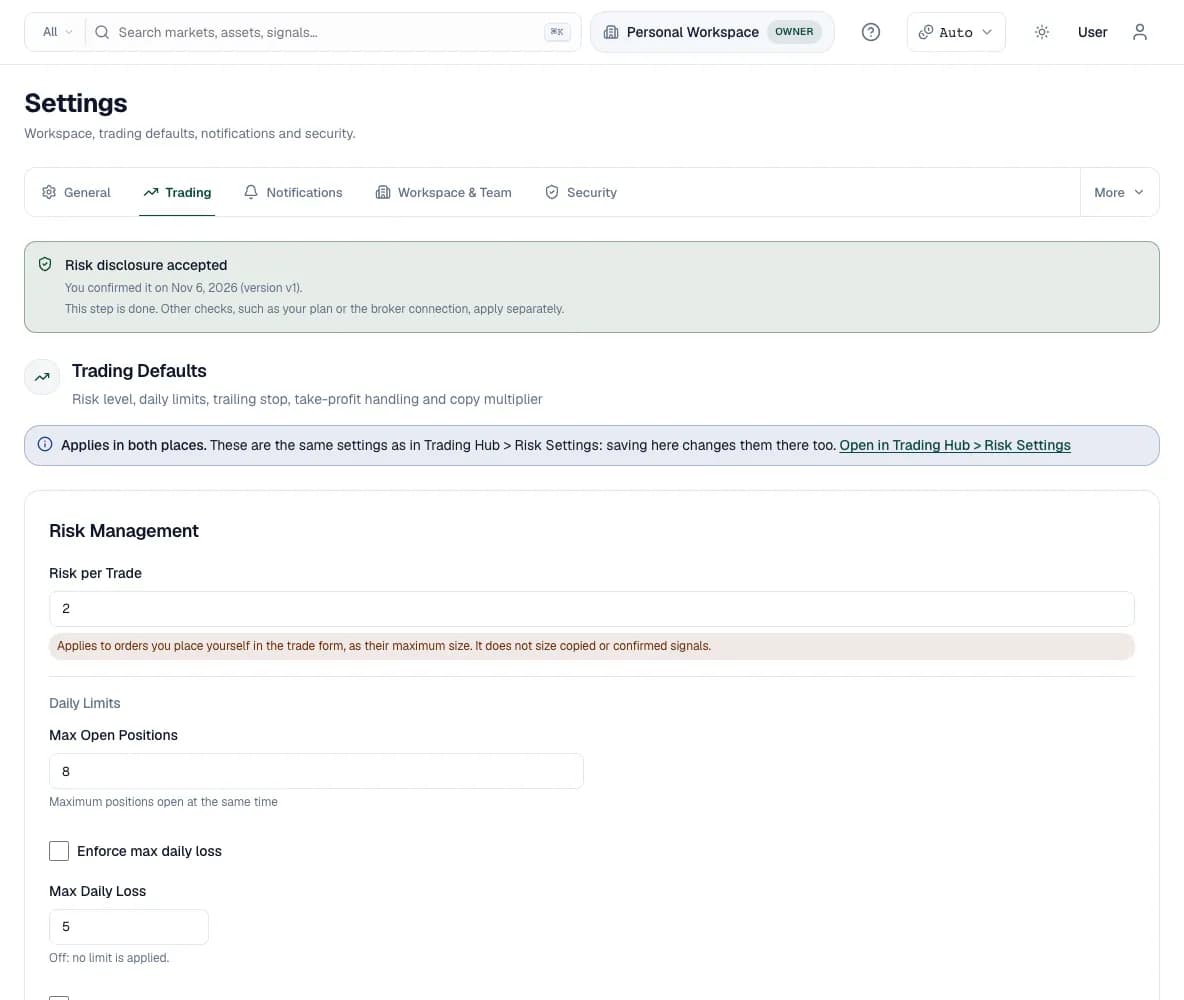
Screenshots show demo data in the English interface. Values are made up and not a performance claim.
Server-side risk management at a glance
How do I set up server-side risk rules?
Risk rules are part of every route's configuration in the PipSync dashboard — there is nothing to install on your machine.
Create your PipSync account and subscribe to a plan
Sign up at app.pipsync.io (the $0 Free plan needs no card but only parses signals), then subscribe to a plan that covers this route (payment method required, cancel any time). Every paid plan is the full product, so you can configure and test risk rules end to end.
Connect a signal source and a trading account
Add a Telegram channel or Discord server as the source (TradingView alerts become signals you review, or trade automatically if you opt in on the Advanced plan; webhooks from other systems always become signals you review), and one of the live destinations — MT5, cTrader, Match-Trader, Binance Futures or Bybit — as the target.
Configure the route's risk rules
Pick a Position Sizing Method (fixed lots, fixed percentage or risk-based) and set min and max lots. Finish with the guardrail: a maximum-open-positions cap.
Verify before going live
Run the route on a demo account (where your platform offers one) or with minimal size until you have watched the rules behave exactly as expected across several real signals.
What is server-side risk management in signal copying?
Server-side risk management means your risk rules live inside the execution pipeline, not in software on your computer. When a signal arrives, PipSync parses it, applies your rules — position sizing, stop-loss and take-profit mapping, trade limits — and only then routes an order to your broker. The order that arrives at the broker already conforms to your settings.
Because the rules sit between the signal and the broker, there is no path around them. A confusing or badly formatted message cannot trigger an oversized order: if a signal does not contain what a rule needs, PipSync errs on the side of not trading rather than guessing.
Why are server-side rules safer than an EA on my terminal?
An Expert Advisor enforces risk rules only while the terminal it runs in is open and connected. If the terminal crashes, the VPS reboots, or a platform update closes MetaTrader overnight, the rules stop with it — exactly the kind of unattended window in which copy-trading mistakes happen.
Server-side rules have no such gap. They run on PipSync's infrastructure as part of order routing, so they apply to every order whether your computer is on or off. You also keep a single rule set per route instead of EA inputs duplicated across terminals — a common source of configuration drift on multi-account setups.
Which risk rules can I enforce before an order reaches my broker?
PipSync checks five kinds of rules on every route before an order is placed, and each route carries its own settings — a conservative funded account and a demo account can follow the same channel with completely different rules.
- Position sizing — fixed lots, or percent-risk per trade so size adapts to each setup
- SL/TP mapping — the signal's levels are carried onto the order, and Telegram signals without a stop-loss and at least one take-profit are not created until the provider adds them
- Maximum open positions — cap how many positions your account can hold at once
- Min and max lots — clamp every order into the size range you set
- Manual approval — leave Auto-Trading off and each signal waits on the Signals page for you to confirm or reject
How does fixed-lot vs. percent-risk sizing work?
With fixed lots, every trade on a route uses exactly the size you set, regardless of what the signal author trades. It is the simplest mode and a common choice while testing a new channel.
With percent-risk sizing, the lot is derived from the risk you are willing to take on the trade and the signal's stop distance, so position size adapts to each setup instead of staying constant. In both modes the signal's own lot size never overrides your rule — your sizing is applied server-side before the order goes out.
Do risk rules remove the risk of trading?
No — and it is worth being precise about this. Server-side risk rules reduce operational mistakes: an oversized position from a misread signal, a trade without a stop-loss, or more concurrent positions than you intended.
They do not remove market risk. Prices gap, spreads widen, and stop orders can fill at worse levels than requested. PipSync is a signal execution tool — it does not provide signals, does not promise any trading results, and is not investment advice. Trading leveraged products involves substantial risk of loss.
Do server-side risk rules help with prop-firm accounts?
They help you apply consistent sizing and trade limits — the area where many prop-account mistakes originate. Percent-risk sizing, min/max lots and maximum open positions are applied before each order, and they keep applying when nobody is watching the account.
Two caveats. Prop firms' rules differ widely — daily-loss formulas, news windows, consistency requirements — so PipSync's guardrails complement your firm's rulebook rather than replace it, and staying inside the firm's specific limits remains your responsibility. And before you connect an evaluation or funded account, verify with the firm that copy-traded or automated execution is permitted at all.
Parse for free, execute on a paid plan
Connect a signal source and watch PipSync parse in real time. Start on the Free plan at $0 with no card, or subscribe from $24/month for execution — charged at checkout, cancel any time.
Billed at checkout · Cancel any time · Free plan available
Risk warning: Trading CFDs and other leveraged products is complex and carries a high risk of losing money rapidly because of leverage. Industry data indicates that 70–80% of retail trading accounts lose money on these products. Risk disclosure · Past performance.
Frequently asked questions
Written by the PipSync team · Reviewed by PipSync Editorial, Editorial team · Published · Last updated
PipSync is a cloud-based signal automation platform that routes trading signals from Telegram, Discord, TradingView alerts and custom webhooks to broker accounts on MetaTrader 5, cTrader, Match-Trader, Binance Futures and Bybit — with server-side risk management and no VPS required. PipSync is an execution tool, not a signal provider and not investment advice.
PipSync is a signal execution tool. It does not provide trading signals, does not guarantee any trading results and is not investment advice. Trading leveraged products involves substantial risk of loss. See the full risk disclosure and performance disclaimer.